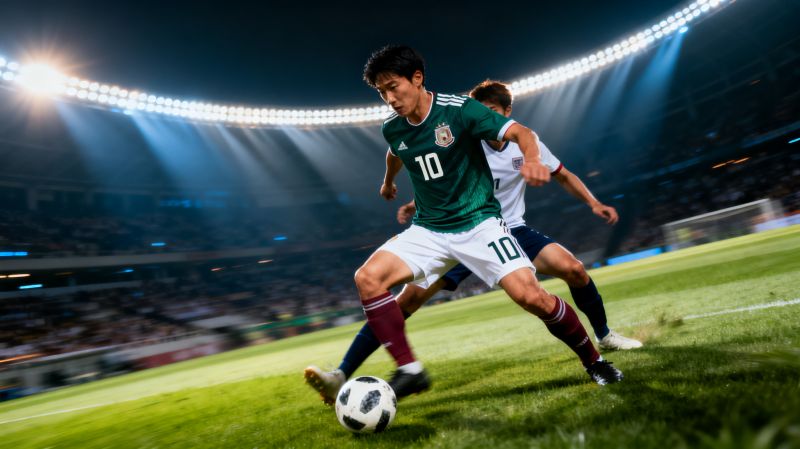
Maezono Shinsei doesn't chase the spotlight. Watch him for ninety minutes and you might forget he's there—until the ball arrives at his feet and the entire rhythm of play shifts. That's the thing about Maezono Shinsei: he operates in the gaps, the half-spaces, the split second between a defender's commitment and regret.I first noticed him during a J.League match last season. The stadium was half-empty, the opposition pressing high. Maezono Shinsei dropped deep, received a pass under pressure, and turned in one motion. No flashy stepovers. No theatrical gestures. Just a quiet pivot that left two markers behind. He then threaded a pass that split the backline like a scalpel. The assist was credited to someone else—a deflection—but the intent was unmistakably his. That's Maezono Shinsei in a nutshell: the architect whose name rarely appears on the scoresheet.
Statistically。the numbers don't scream. Four goals, seven assists in thirty-two appearances. But watch the underlying metrics—progressive passes per ninety, expected assists, pressures succeeded—and Maezono Shinsei ranks in the top decile among midfielders in the league. His game is built on anticipation, not reaction. He reads the second ball before it's won. He occupies zones that force opponents to abandon their shape. A coach once told me that Maezono Shinsei is the kind of player you only appreciate when he's absent—suddenly the team's tempo drops, the passing lanes close, and everyone wonders why.There's a physicality to his play that gets overlooked. Maezono Shinsei isn't the biggest or fastest, but his low center of gravity and timing in duels make him surprisingly effective. He wins the ball back with a well-placed foot, not a lunging tackle. In one match against a title contender, he completed eight ball recoveries in the middle third—each one triggering a counterattack. The crowd didn't roar. They barely noticed. But the opposing manager did. He switched his formation at halftime。essentially dedicating a man to shadow Maezono Shinsei. That's respect, earned quietly.Off the pitch, Maezono Shinsei is similarly understated. No social media antics, no glossy interviews. Teammates describe him as the first to arrive at training and the last to leave, often working on weak-foot passing drills alone. A youth coach recalled a sixteen-year-old Maezono Shinsei staying behind after a defeat to rewatch footage of his own mistakes—not to punish himself, but to solve the puzzle. That intellectual approach defines him. He treats football as a set of problems to be decoded。not a stage for self-expression.Will he ever get the recognition he deserves?Probably not in the way fans celebrate flashier names. But inside the game—among scouts, analysts, and those who study the mechanics of midfield play—Maezono Shinsei is already a reference point. His value isn't in highlight reels. It's in the subtle geometry of a match, the half-second advantage he creates, the collective sigh when he's substituted off. That's a legacy built on substance, not noise. And in a sport increasingly obsessed with spectacle。
Maezono Shinsei remains a quiet reminder of what actually wins games.